

The Role of Design in the Age of AI Transformation
Picture this in your head. Take the most technologically advanced electric motor from an electric car and drop it into a 20-year-old Honda Civic. The motor will fit just fine. On the surface, it looks fine, but once you take a seat inside the car, that's when you see trouble popping up. The motor doesn't rev, so the tachometer reads zero. The same thing is happening with the fuel gauge. It's meaningless now because there is no fuel in an electric car engine. Half the buttons on the car dashboard no longer work, leaving you without control over any new features the motor may offer. You have more power than you have ever had but without the appropriate harness to take advantage of it.
That metaphor sums up AI on legacy software in a nutshell. I've seen firsthand the effect it has on companies and the people working in them. It's hard to break decades of habit. A worker who has run the same system for years and years opens the new AI panel, types a prompt, and gets a correct, concise answer in less than two seconds. But then the worker would go to the source and verify the answer manually line by line, which takes longer than just doing the task without AI.
The consensus from the boardroom is to blame the engine, and that is the easy way out. But the engine is fine. What fails is the dashboard. The dashboard is the harness that's been in place for decades. When you read all those stats about the infamous “pilot purgatory” that's not a judgment on AI as a technology. That's just the outcome of trying to implement AI on software with an outdated interface.
Software operates differently with or without AI
Every gauge in the Old Civic is connected to the same instrument that does the same function every single time. Software used to behave the same way. It would always have the same input and give out the same output 100% of the time. Every piece of the interface was built based on that relationship, and that is what people have come to trust.
AI operates differently because AI guesses. The same question on Tuesday can have a different answer on Wednesday, and a wrong answer can look just as convincing as a right one. The dashboard doesn't have the ability to decipher that. It just shows the AI's best guess, just like it shows the output from the old software.
Interface design used to run entirely on certainty, and now, with AI, that certainty is sometimes gone. In decades of interface design, we never built a screen whose job was to say, "I could be wrong," or "I'm still thinking," or "This is just a guess." We never had to design an interface to show the reason why the software is unsure.
On the very surface, it doesn't seem that critical, but the cost of that uncertainty is trust. When a system you've relied on for years shows you a wrong answer with complete confidence, the whole car feels broken. People would stop trusting the whole machine, not just the feature. Designing software to admit doubt is the new craft. Companies whose AI shows its reasoning and thinking witness their adoption rise by roughly a third. This is not a shock because people's level of trust increases when they can see the thinking behind the process.
Two cockpits, two languages
The second misunderstanding comes in how you drive that car. The old dashboard is straightforward. You operate the controls, and it does exactly what you ask it to. All of these menus, forms, buttons, and all the interfaces were designed for that. The new cockpit is a self-driving car. You give it a destination, not instructions on how to get there. You say where you want to go, and it will figure out a way to get there. Currently, there is no dashboard that can speak both languages at once.
Bolting one onto the other causes the driver to freeze on a question the dashboard never had to answer before. Do I steer, or do I tell it where to go? Most people do both, badly, then swiftly go back to the way they've always driven. This doesn't come from stubbornness, but rather from 20 years of muscle memory.
Most companies would just file this under change management and hope that training can just solve it. But that's where they're wrong. Changing human behavior is not a training problem. A workshop to teach eating soup using a fork is doomed to fail. This is the design opportunity of the decade. A good design needs no introduction or training because it teaches itself.
The Verdo AI-Readiness Stack
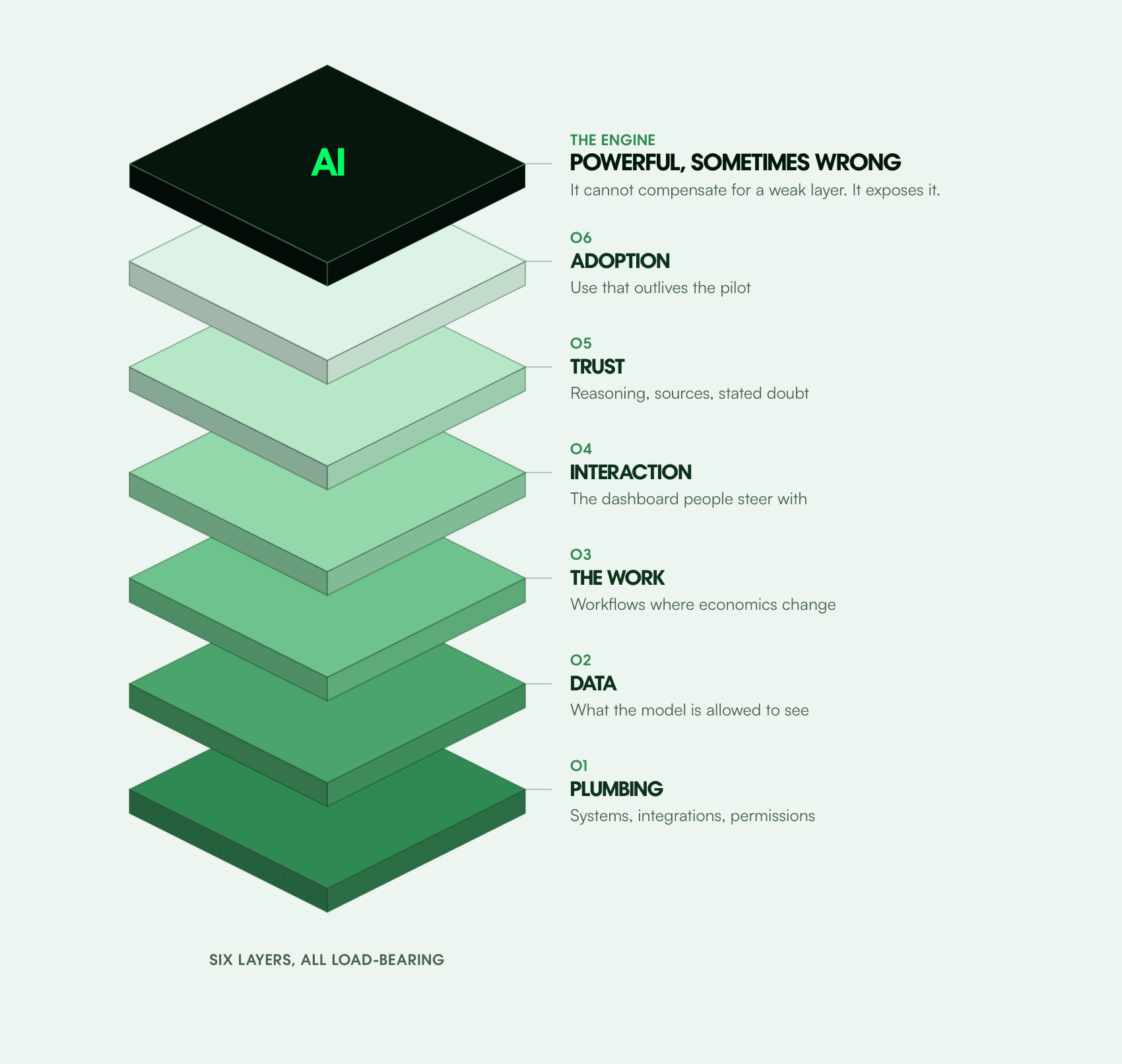
Tesla didn't drop their motor into an existing car. They designed their car based on what the new powertrain made possible: screen, controls, the way you drive. Swapping the motor was the smallest part of the job. It needed a battery the Civic never had to carry, wiring it never had, and a charging network it never required. We give clients that checklist as The Verdo AI Readiness Stack, six layers that all have to hold: the work itself, the data, the plumbing underneath, how people interact with it, how it earns trust, and how people come to adopt it. If any layer under the AI is weak, the AI can't compensate for it. It exposes the problem instead.
You don't have to rebuild the whole car. It's not about rebuilding everything, so pause if you hear anyone claim it is. Rebuild the few workflows where the intelligence directly changes the economics, and design those dashboards genuinely for an engine that is powerful and sometimes wrong. Show where the answer came from, how sure the system is, what will happen before it acts. Then let people's trust climb naturally. Full self-driving is the last level of earned trust, not a switch you flip after a good demo.
Design has done this before
When the iPhone first came out, having people type on a sheet of glass was the strangest experience. Every touch feels the same. The texture never changes in a piece of glass, so how do you show feedback when something is pressed correctly? The iPhone keyboard would show the key you pressed, popping up the UI to indicate what you pressed. On top of that, they added audio to provide auditory feedback. Not so long ago, they even added haptic feedback for that extra touch. And now typing on your phone feels like the most natural thing.
Enterprise AI is waiting for this exact moment. The gap between a 3.3 percent adoption rate and what the new motor can do is neither a model gap nor a training gap. It is a bridge nobody has designed yet: the design that can reshape a career's worth of muscle memory, the screens that teach a machine's newfound doubt, and the slow handover of control at the pace trust can absorb.
Don't read all those posts about the “pilot purgatory” or the insanely high failure rates on AI adoption as a technology verdict. Read it as an unanswered design brief, the largest to land on our desks since the screen went multitouch. The motor is here, and the drivers are willing. Someone has to design the way across, and it has to be us.
Ready to turn AI investment into real outcomes?
Book Time With An AI Strategist